
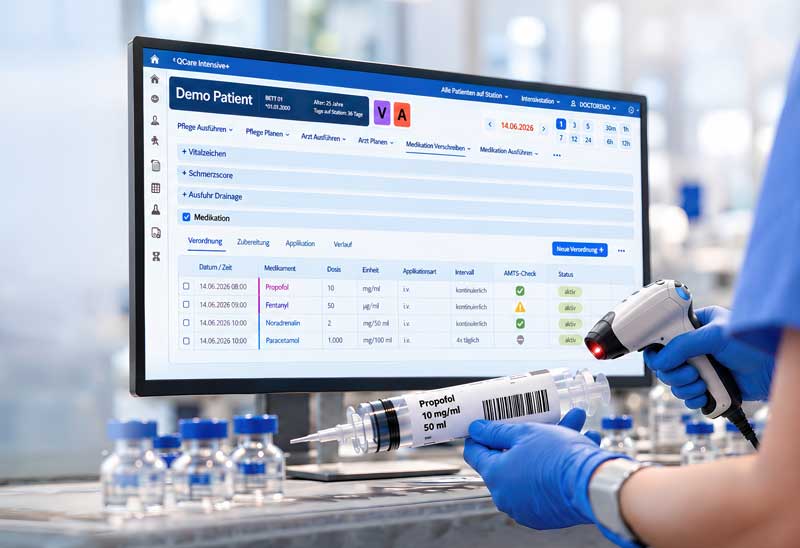
The prescription defines which medication a patient is to receive. The administration documentation records what was actually given. In between, several teams may be involved in preparation, labeling, and administration. A closed-loop medication process keeps these steps linked to the original prescription.
The closed-loop module in QCare Medication connects the steps in a seamless digital workflow. At the point of care, the treatment team can match the patient, the prepared medication, and the associated prescription. The documented administration flows back into the medication process, closing the loop.
Four steps from prescribing to documented administration
Each step provides the information for the next. Feedback from the documented administration establishes the link to the original prescription.

1. Digital Prescription
The prescription is recorded in a structured manner. This ensures that the teams involved in preparation and administration have access to the same information regarding what was prescribed.

2. Preparation and Labeling
QCare Medication supports planning and preparation and integrates labeling into the same workflow. The prepared medication can be identified via the label during subsequent verification.

3. Verification during Administration
At the point of care, the team matches the patient, medication, and prescription. Administration is documented where it occurs and where the medication and its prescription are present.

4. Documentation and traceability
Following documentation, QCare Medication automatically feeds the administration record back into the medication workflow. This ensures that the connection between the original prescription and the documented administration remains traceable.
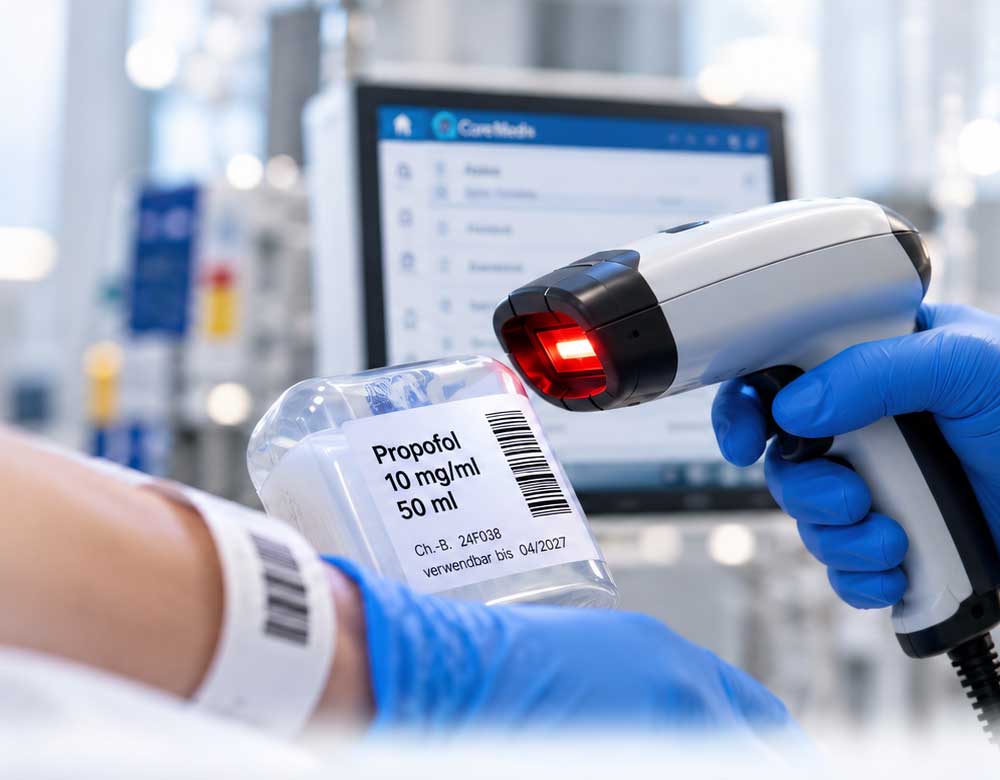
How does bedside verification contribute to the closed loop?
The same medication can appear in multiple prescriptions. Verification brings together three pieces of information for the upcoming administration: the patient's identity, the prepared medication, and the specific prescription. The photo shows how the barcode on the medication label can be scanned at the bedside.
Verification establishes the link to the prescription at the point of care. The documented administration closes the loop. During later review, such as during a shift handover, the team can trace what was prescribed and which administration was documented.
Optional Medication Therapy Safety Checks
The optional AMTS module supplements the closed-loop medication process with medication therapy safety checks. It supports both medication-specific and patient-specific safety checks.
Availability in QCare
HIM has announced the closed-loop module for QCare starting with version 187.8.

